
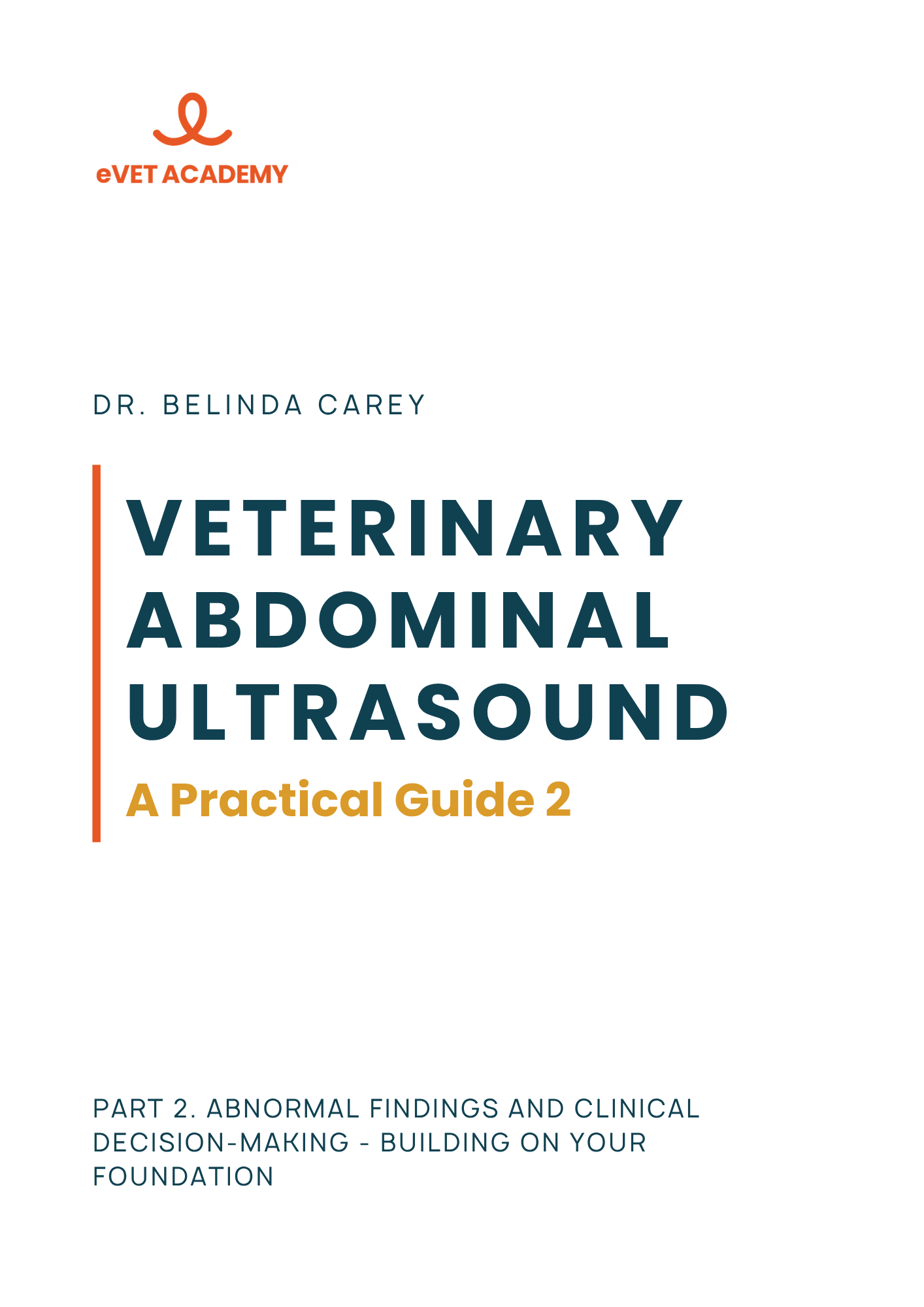
Know what that finding means and what to do next
The advanced small animal ultrasound guide for abnormal abdominal findings
You’ve got the foundations. Now you need to know what to do when the image looks abnormal.
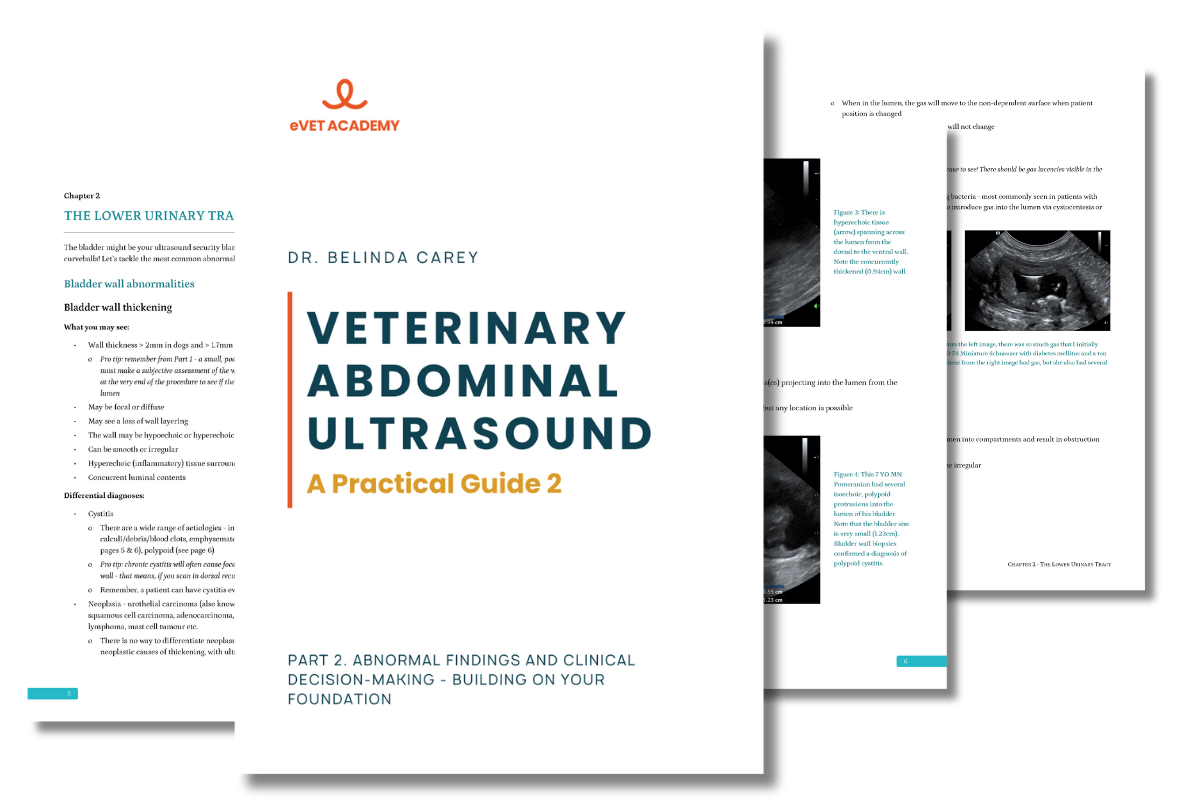
Guide 2 takes you through veterinary ultrasonography in real clinical terms. It covers the abnormalities you’ll encounter in practice, with a structured framework for interpreting what you’re seeing and deciding what to do next.
$63 USD
3,350 vets trained across 97 countries
Instant download to any device, start today
114 pages covering abnormal canine and feline abdominal ultrasound
3,350 vets trained across 97 countries
Instant download to any device, start today
114 pages covering abnormal canine and feline abdominal ultrasound
Sound familiar?
You’ve found something. You’re not entirely sure what you’re looking at. You have a feeling it matters, but you’re not sure how much, what it means or what to do next.
So you refer. Or you monitor. Or you order more tests. And somewhere in the back of your mind, you’re not completely sure any of those were the right calls.
That uncertainty costs time. Building a differential from scratch takes longer when you don't have a clear framework to work from.
It costs confidence. Every uncertain finding compounds. Every referral you weren't sure was necessary sits with you a little longer than it should.
And occasionally, it costs a patient a diagnosis that should have been made sooner.
It’s because the training taught you to recognise abnormalities and then left you to figure out what to do with them. Guide 2 fills that gap.
By the end of Guide 2, you’ll be able to:
- Recognise abnormal findings across every major abdominal organ and identify whether they’re clinically significant or incidental
- Interpret changes across the liver, spleen, kidneys, pancreas and adrenal glands and understand what they mean for your patient
- Build a structured differentials list for every abnormal finding rather than relying on recall under pressure
- Decide confidently when to act, when to monitor and when to refer, based on what you’re actually seeing
- Assess gastrointestinal ultrasonography systematically, including GI wall abnormalities and measuring wall layers
- Interpret free fluid, gas and mass-like lesions with context and clarity rather than defaulting to referral
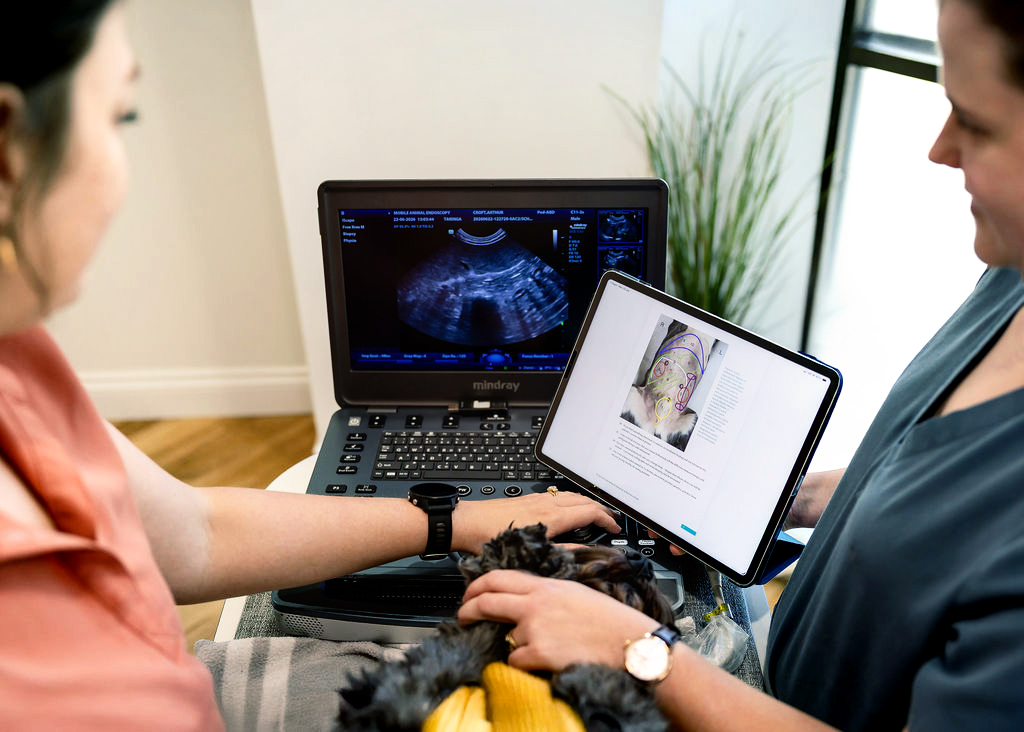
What’s inside:
114 pages of abnormal canine and feline abdominal ultrasound findings.
Deep enough to cover the abnormalities you’ll encounter in real general practice, specific enough to be useful when you’re actually in front of them.
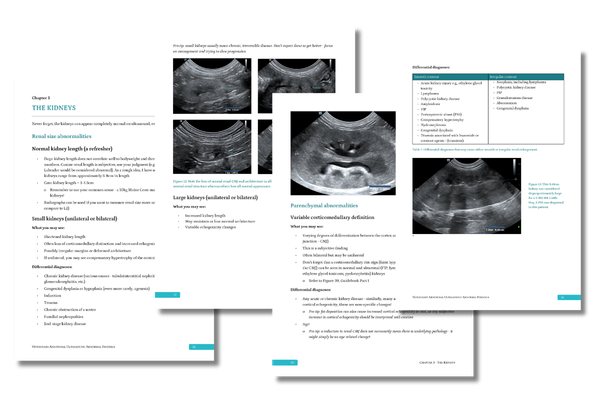
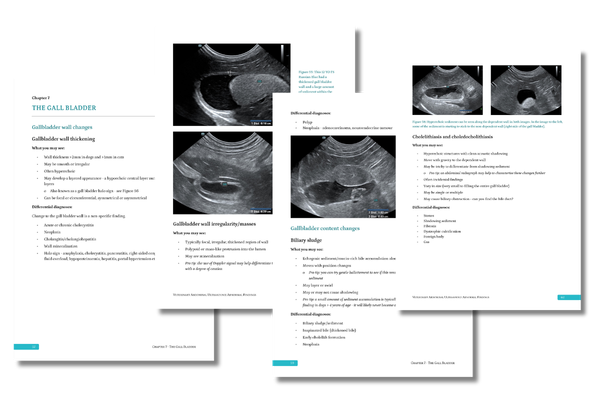
100+ images of abnormal ultrasound findings.
Compare directly against your own scans so you can see what you’re dealing with, not just read about it.
A differentials list and next-step suggestions for every chapter.
Cytology, histopathology, radiographs and more, so every finding comes with a plan, not just a description.
Detailed guidance on diagnostic imaging for dogs and cats across the key organs.
Including gastrointestinal ultrasonography and measuring wall layers, canine adrenal imaging and sonographic evaluation of the pancreas.
Step-by-step organ-by-organ guidance across every major abdominal structure.
Real clinical images throughout, in the same logical sequence you’ll use in clinic every time.
Pro tips and clinical pearls from a real veterinary ultrasonographer.
Not from a textbook. From a vet who has performed advanced small animal ultrasound in thousands of real clinic settings.
Clickable table of contents.
Jump straight to the organ or finding you need mid-scan without scrolling through the whole guide to find it.
Instant digital download to any device.
Yours to keep and accessible from your phone, tablet or laptop the moment you need it.
What changes after Guide 2
You have a framework.
When you find something that doesn’t look right, you know how to approach it. Organ by organ, finding by finding, with a structured process for deciding what it means and what to do next.
You have a differentials list.
Structured, clinically relevant differentials for every abnormal appearance so you’re presenting findings to clients with confidence and discussing cases with colleagues from a position of knowledge.
You have a decision-making tool.
A clearer sense of when to act, when to monitor and when to refer. You stop defaulting to referral every time something looks unfamiliar. The second-guessing gets quieter with every scan you do.
You have confidence.
You’ll catch findings that might otherwise have been missed, make clearer recommendations and feel assured at the end of a scanning day that you made the best decisions you could.
Your posts and the first book helped me get through this first year of practice. I felt more confident whenever I had to do an ultrasound and I had such a clear vision of the organs and how I should examine them. I even found things my more experienced colleagues didn’t, just because I was looking carefully and not scared. I even diagnosed some difficult cases and received confirmation that I was right.
Is this guide right for you?
You've completed Guide 1 and you're ready for the next step.
You have the baseline. Now you need the interpretive layer that sits on top of it. Guide 2 takes everything you built and gives you a structured framework for what to do when the image stops looking normal.
You've been scanning for years and want to strengthen your interpretation.
You’re competent but there are findings that still make you pause, differentials you’re building from memory and referrals you’re not always sure were necessary. Guide 2 gives you the structure to work through abnormal findings with more confidence and consistency.
Vet student, vet nurse or practice manager?
Guide 2 is used across the full spectrum of veterinary roles. If you’re involved in ultrasound interpretation or want to understand what abnormal findings mean clinically, this guide is relevant.
Know what to do when something doesn’t look right
The vets who get better at small animal ultrasound interpretation are the ones who invest in the right tools and then actually use them.
Confidence in interpretation comes from having a clear framework and doing the work.
$63 USD
Trusted by 3,350 vets across 97 countries.
Instant digital download.
Trusted by 3,350 vets across 97 countries.
Instant digital download.
Want to scan smarter from day one?
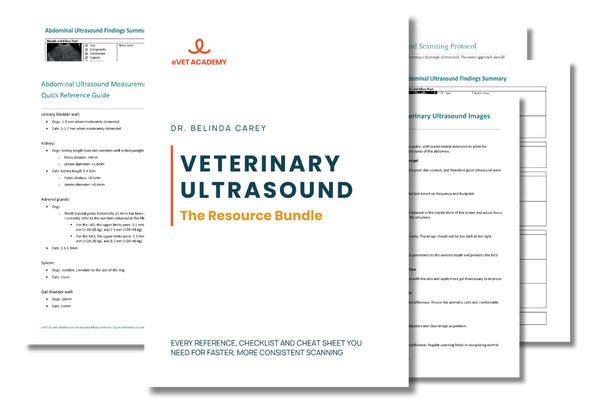
The eVet Resource Bundle gives you twelve practical reference tools for $22 USD with image quality tips, a scanning protocol, measurement references, a findings summary, a client handout and more.
Want to save time on reporting?
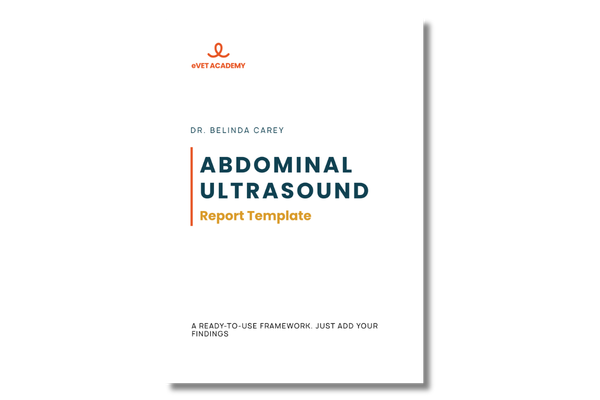
Our Ultrasound Reporting Template is a pre-structured veterinary abdominal ultrasound report covering every major organ system, plus two fully completed example reports with accompanying images showing how to describe findings and frame recommendations.
Questions you might be asking
How do I receive my guide?
As soon as your purchase is confirmed, you will receive an email receipt with your download link. The guide is a PDF. Save it to your phone, tablet or laptop and it is yours to access whenever you need it. Most vets keep it open on a device by their ultrasound machine.
I am experienced. Will I learn anything new?
Most experienced vets find the differentials lists and next-step suggestions the most valuable part of Guide 2 because having it structured and written down changes how they work under pressure.
Do I need Guide 1 before Guide 2?
Guide 2 works best when you have a solid grasp of normal appearances, so Guide 1 is the recommended starting point. That said, experienced vets who are confident with normal findings can use Guide 2 independently. If you’d like both, purchasing Guide 1 and Guide 2 together is the most efficient way to get the complete picture.
What currency is the price in?
All prices are in USD. Your bank or payment provider will handle the conversion automatically at checkout.
How is this different from a specialist ultrasound report?
A specialist ultrasound report describes what a radiologist sees. Guide 2 is written for the vet performing the scan in general practice. It tells you what to look for, how to interpret what you find, what the differentials are and what to do next. It is a clinical decision-making tool.
What format is the guide in and what do I need to open it?
The guide is a PDF that opens on any device. If you can open an email attachment, you can open this guide.
What is the difference between Guide 1 and Guide 2?
Guide 1 covers normal abdominal ultrasound findings, the baseline you need before you can confidently interpret anything.
Guide 2 covers abnormal findings and takes you into interpretation and clinical decision-making across every major organ. They are designed to work together.
Is this guide suitable for vet students and vet nurses?
Yes. Guide 2 is used across the full spectrum of veterinary roles. If you are involved in ultrasound in any capacity or want to understand what abnormal findings mean clinically, this guide is relevant.
Can I share the guide with my colleagues or clinic?
The guide is licensed for individual use. If your clinic wants access for multiple team members, get in touch.
I am based outside Australia. Will this guide work for me?
Yes. The guides are used by vets in 97 countries. The anatomy and pathology do not change across borders and the guide covers both canine and feline abnormal findings.