
The step-by-step adrenal gland ultrasound guide for small animal vets
Three proven techniques and diagrams for reliable adrenal gland ultrasound in dogs and cats
The adrenal glands are small, tucked away and easy to miss. They’re also clinically significant enough that finding them consistently (and knowing what you’re looking at when you do) changes how you practise.
Stop asking “where even are they?” and learn how to find them confidently, every time. Gain three different techniques, purpose-drawn diagrams and a clear framework for interpreting what you find.
$57 USD
Trusted by 3,350 vets across 97 countries
Instant download to any device, start today
Covers normal and abnormal adrenal findings in dogs and cats
Trusted by 3,350 vets across 97 countries
Instant download to any device, start today
Covers normal and abnormal adrenal findings in dogs and cats
I have seen many videos online as well as even some paid ones (plus few books), but none of those explained how to find adrenal glands ‘practically’.
Your way of training is very ‘real’ (not just text) and easy to understand. I already started getting success (of course, with multiple resets) after reading your abdominal guide. After the masterclass, I am feeling very confident in finding adrenals.
I also want to add that before reading your guide, I was trying both recumbent positions and both techniques (kidney marker and follow the aorta), but was never successful, as I was missing the basic concept . Thank you very much!
Sound familiar?
Most vets skip the adrenals. They know they’re important, but they’ve never had a reliable system for finding them.
A few scans that run too long without answers teach you to stop looking.
So you move on. You write the report. You tell yourself the adrenals were probably fine. But you’re not entirely sure that’s true.
It’s not your ability or your machine. Nobody ever gave you a repeatable system. Without one, you’re not scanning. You’re searching.
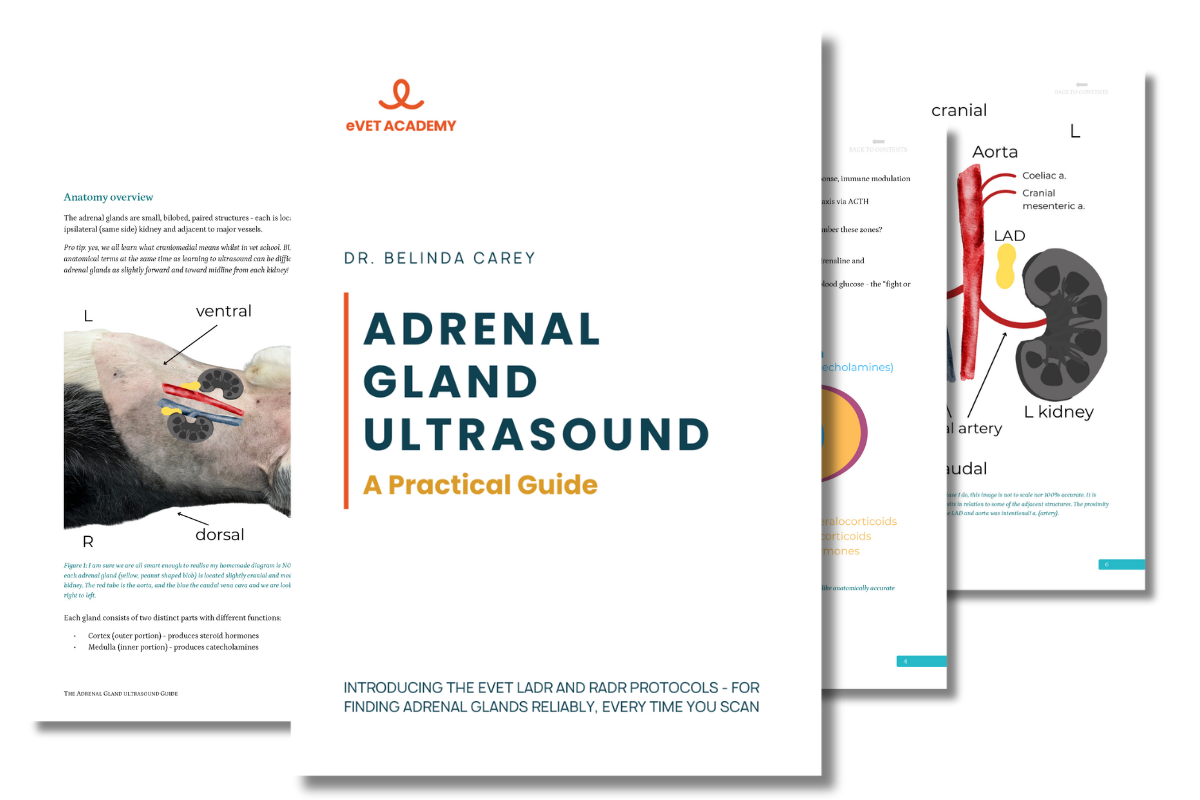
This guide gives you that system. Three proven techniques, including eVet’s proprietary LADR and RADR protocols, purpose-drawn diagrams showing where to look and a framework for interpreting what you find.
The adrenal glands become a confident part of every scan.
By the end of this guide, you’ll be able to:
- Locate both adrenal glands reliably using three proven techniques (including our proprietary eVet LADR and RADR protocols), giving you a different approach for every patient and every situation
- Identify normal adrenal appearances in dogs and cats, including how to measure size accurately, assess shape and interpret echogenicity, so you have a reliable baseline for every patient
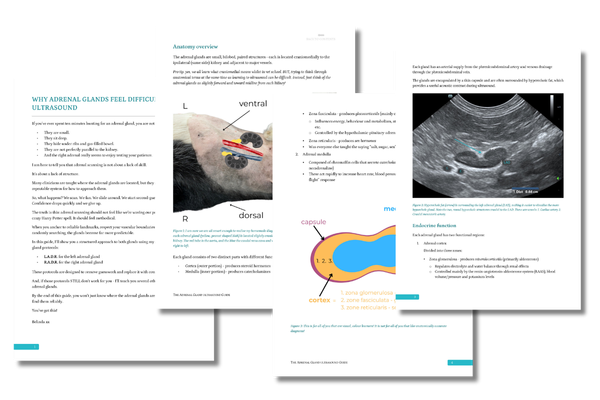
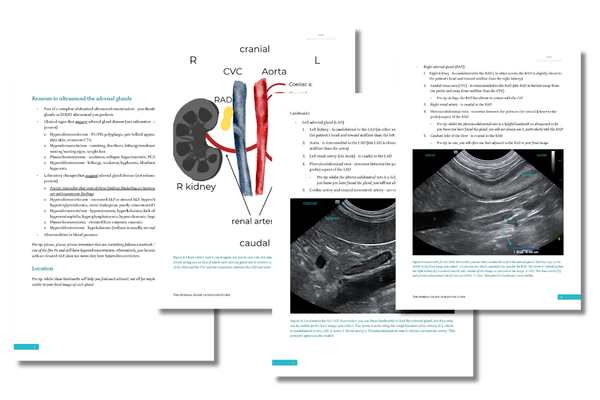
- Follow purpose-drawn diagrams that show you where to place the probe, how to move it and what you should be seeing at every step
- Recognise common abnormal adrenal findings and understand what they mean clinically
- Build a structured differential list for abnormal findings rather than relying on recall under pressure
- Incorporate adrenal assessment into your routine abdominal scan without adding significant time
- Know exactly what to do next based on what you find and feel confident in your reports and recommendations
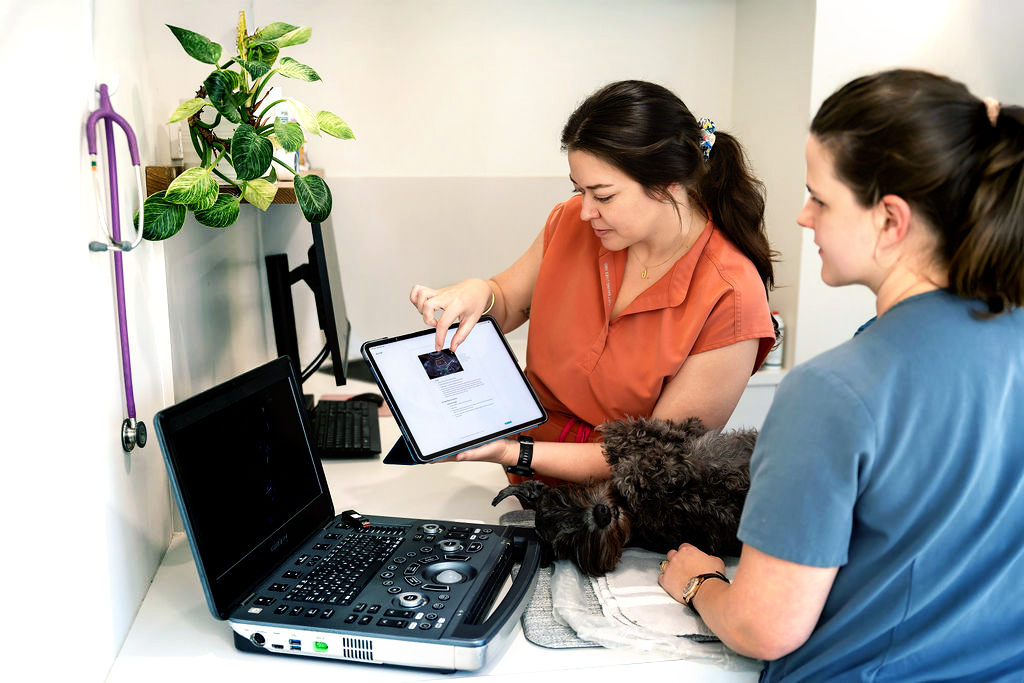
What’s inside
Three different techniques for finding the adrenal glands in dogs and cats.
The proprietary eVet LADR protocol for the left adrenal, the eVet RADR protocol for the right, a technique utilising the major vessels to find the adrenals and a third, intercostal technique for those patients where the first two need a backup.
Purpose-drawn diagrams for every step.
Designed specifically to show you where to place the probe, how to move it and what the adrenal glands look like when you find them.
Normal adrenal appearances and measurements.
Size, shape and echogenicity covered in full, so you know immediately whether what you’re seeing is within normal range or worth investigating further.
Common abnormalities and differentials.
What changes, what it means clinically and what to do next, so every abnormal finding comes with a plan.
Positioning, probe tips and landmarks that actually work.
The practical detail that makes the difference between searching and finding.
An adrenal gland troubleshooting guide.
For the patients who make it difficult, this section gives you a systematic way to work through the problem rather than giving up.
Pro tips and clinical pearls from real general practice.
From a vet who has found (and missed) adrenal glands in real clinic settings and learned what makes the difference.
Instant digital download to any device.
Yours to keep and accessible from your phone, tablet or laptop when you need it.
What changes after the Adrenal Guide
You stop skipping the adrenals.
The adrenal glands stop being the structure you hope isn’t relevant to this case. They become part of every scan: assessed consistently, documented confidently and no longer a source of uncertainty.
You have three systems.
The LADR and RADR protocols, plus the follow the vessels technique and the intercostal technique, give you a clear, repeatable starting point for every patient. You’ll know exactly where to begin, how to move and what you’re looking for. When one approach isn’t working, you have two more to fall back on.
You have a troubleshooting plan.
When a patient makes it difficult (deep-chested, gassy, uncooperative), you have a systematic way to work through the problem rather than giving up and moving on.
You have confidence.
The kind that comes from finding the adrenals on a patient you would previously have written off as too difficult. From knowing what you’re looking at when you do find them. From leaving a scan knowing you covered everything you should have.
I just wanted to let you know I found an adrenal today using your guide. For starters, for some reason I thought the adrenal was at the caudal end of the kidney so I had also been looking at the wrong end, so the diagrams you put in the guide really work. And then I just used your kidney to blood vessel fanning protocol.
Is this guide right for you?
You've been avoiding the adrenals.
You know they’re clinically relevant. You know you should be assessing them. You just haven’t found a technique that works reliably enough to make it worth the time. This guide gives you three practical techniques with diagrams that show you exactly where to look.
You find them inconsistently.
Some patients, no problem. Others, you scan for longer than you should and give up. The LADR and RADR protocols iron out that inconsistency, so you’re finding them the same way every time, regardless of how cooperative the patient is.
You're unsure what you're seeing when you do find them.
Finding the adrenals is one thing. Knowing whether what you’re looking at is normal, abnormal or worth investigating further is another. This guide covers both technique and interpretation in the same place.
Ready to make the adrenals part of every scan?
The vets who find the adrenals consistently are the ones who have a system and use it every time. Confidence comes from repetition and repetition starts with having the right technique.
The adrenals were never actually that hard to find. They were just waiting for someone to show you where to look.
$57 USD
Trusted by 3,350 vets across 97 countries.
Trusted by 3,350 vets across 97 countries.
Instant digital download.
Instant digital download.
Want to scan smarter from day one?
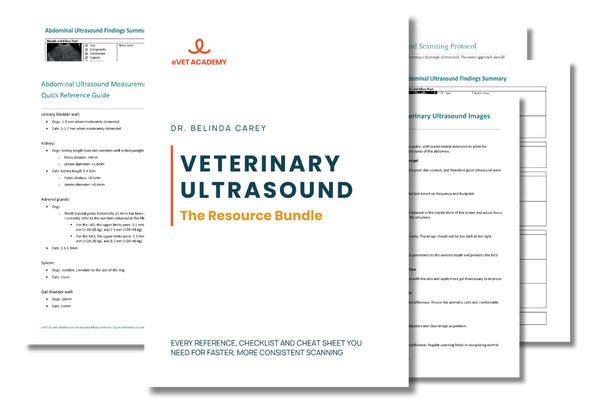
The eVet Resource Bundle gives you twelve practical reference tools for $22 USD with image quality tips, a scanning protocol, measurement references, a findings summary, a client handout and more.
Want to see the protocols in action?
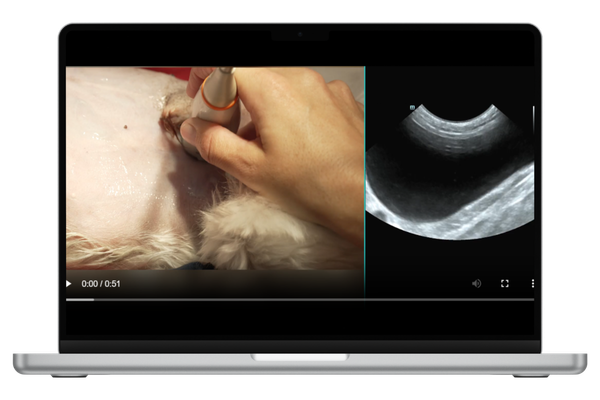
The Adrenal Gland Ultrasound Masterclass demonstrates these techniques on screen, including the LADR and RADR protocols in real time. Includes:
- Clear camera angles showing exactly where the probe is and how it’s moving
- Techniques demonstrated on real patients
- Q&A from the original live session included
- A short quiz for RACE CE credit (pass at 70% to claim your 1 hour of RACE-approved continuing education)
Questions you might be asking
How do I receive my guide?
As soon as your purchase is confirmed, you’ll receive an email receipt with your download link. The guide is a PDF. Save it to your phone, tablet or laptop, and it’s yours to access whenever you need it.
What are the LADR and RADR protocols?
The LADR and RADR protocols are eVet’s proprietary step-by-step systems for finding the left and right adrenal glands reliably. Each is built around a simple acronym that gives you a repeatable starting point so you know exactly where to begin and how to move.
Do I need Guide 1 or Guide 2 before this guide?
The adrenal guide works as a standalone resource. That said, it pairs naturally with Guide 1 and Guide 2. The broader guides give you the systematic foundation. This guide gives you a focused deep dive into one of the trickiest structures to image consistently.
What is the Adrenal Toolkit?
The Adrenal Toolkit is a collection of seven practical resources available as an add-on at checkout for $17 USD. Trackers, checklists, flowcharts and quick reference guides to help you apply what you’ve learned without overthinking it.
Is this guide suitable for vet students and vet nurses?
Yes. If you’re involved in ultrasound in any capacity or want to understand adrenal assessment more clearly, this guide is relevant. The adrenal glands do not discriminate by job title.
What currency is the price in?
All prices are in USD. Your bank or payment provider will handle the conversion automatically at checkout.
What format is the guide in and what do I need to open it?
The guide is a PDF that opens on any device. If you can open an email attachment, you can open this guide. No IT support required.
I'm based outside Australia. Will this guide work for me?
Yes. The guide is used by vets in 97 countries. The anatomy doesn’t change across borders, and the guide covers both canine and feline adrenal findings. The adrenal glands are in the same place regardless of which hemisphere you’re scanning in.