
A Proficient Prostate Protocol
Greetings Scan Squad!
Do you struggle to find the prostate? If so, you’re one of many, so please do not feel alone!
My first question always is: are you sure it’s a boy?
Just kidding, it’s: can you find the urinary bladder?
If you can find the urinary bladder, you can find the prostate, in a dog. Of course male cats also have a prostate, but it is very difficult to find on ultrasound and I wouldn’t recommend that you waste your time looking!
To find the prostate:
-
Position your probe in longitudinal (probe marker facing cranially) and find the urinary bladder
-
Slide caudally to the trigone where the bladder narrows/tapers to the urethra
-
Keep your probe centrally over the trigone so that you can see the proximal urethra exiting the bladder
-
Then slide slowly caudally again, keeping the urethra in view – the prostate is usually only a few centimetres caudal to the urinary bladder and you can usually still see the bladder in the cranial portion of your image
-
Scan in both longitudinal and transverse views
-
Remember the prostate will look different in castrated vs entire patients (see below)
Don’t forget to do a rectal to feel the prostate!
The only reason you shouldn’t be doing a rectal is if you don’t have a finger or the dog doesn’t have an anus!
Happy scanning!
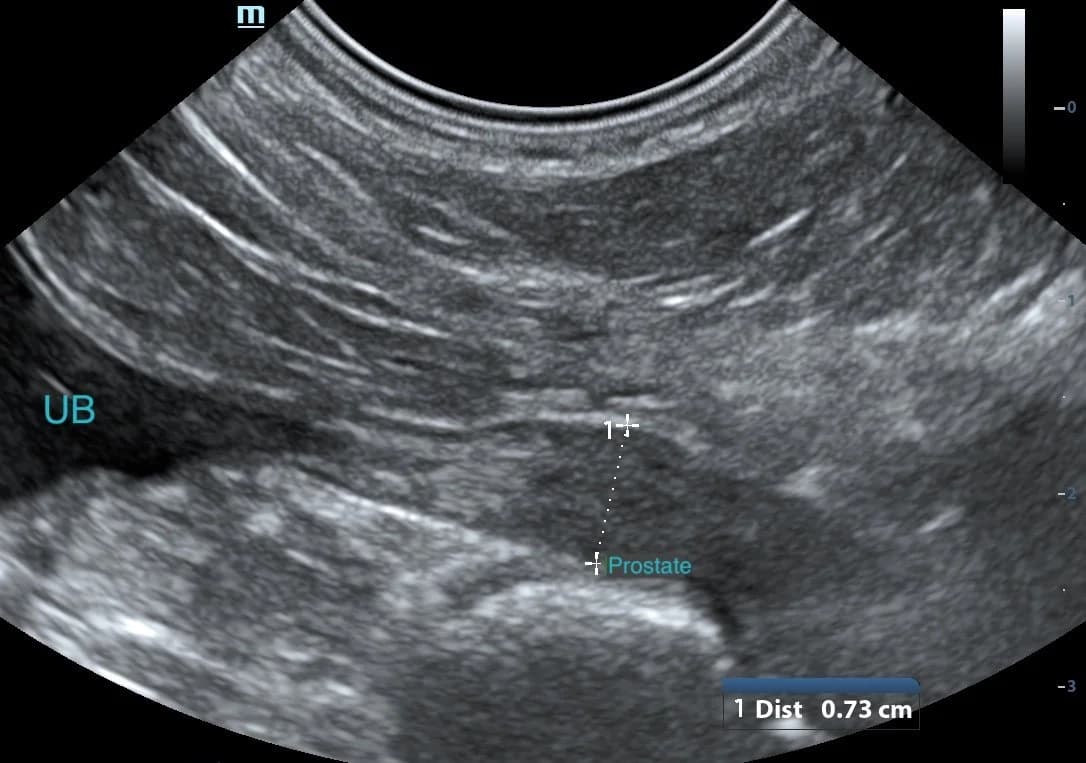
Longitudinal view of the prostate in a castrated dog. Note the proximity of the urinary bladder (UB).
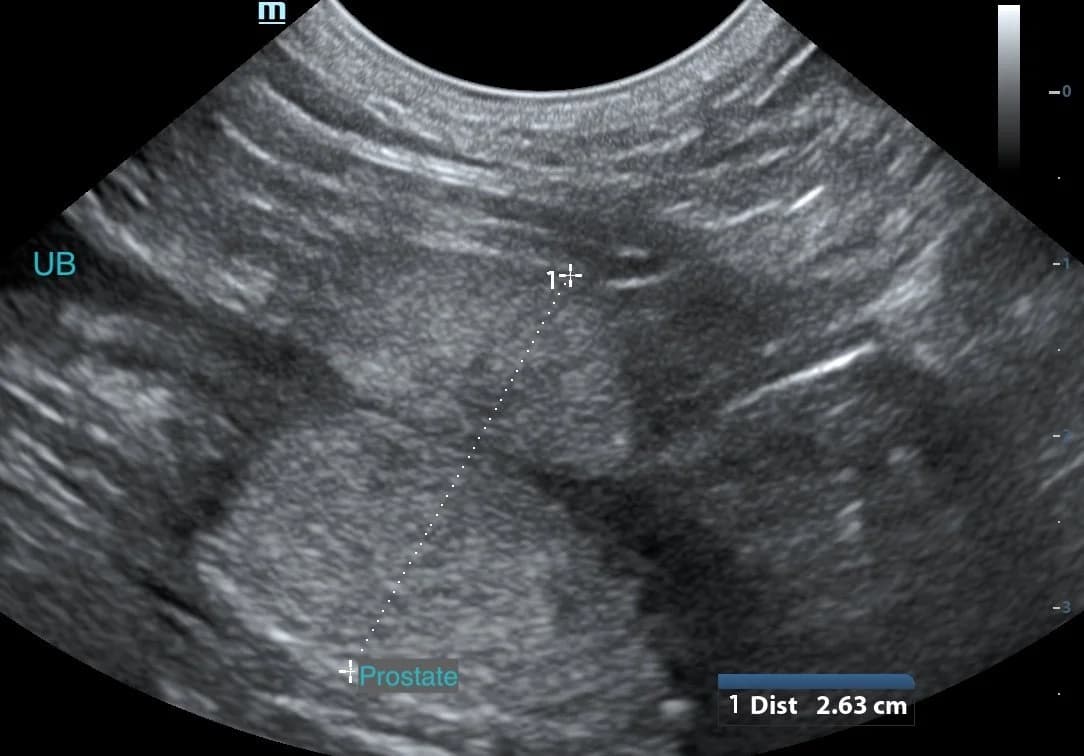
The longitudinal view of the prostate in this 9 MO ME Corgi shows a larger, more hyperechoic prostate. These changes are consistent with his entire status. The UB is still visible!
About Belinda
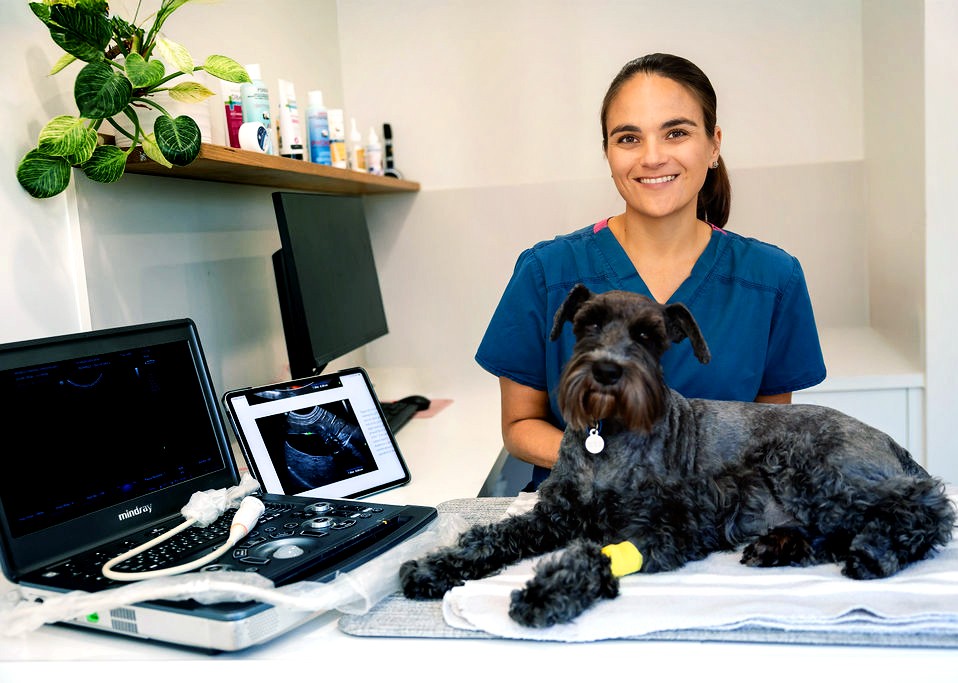
Dr. Belinda Carey is a veterinarian, educator and founder of eVet Academy, with a passion for making veterinary ultrasound practical and accessible. After graduating with first-class honours and earning her MANZCVS in Small Animal Internal Medicine, Belinda spent years providing mobile ultrasound services to general practice clinics, where she recognised a widespread need for practical, step-by-step ultrasound training.
Combining her veterinary expertise with her teaching background, she created eVet Academy to help small animal vets build confidence and improve their scanning skills through clear, clinically relevant education designed for everyday practice.
Browse our other articles
Pathology or Artifact?
Pathology or Artifact? Greetings Scan Squad! One of my instagram posts last week highlighted the importance of testicular scanning. “Hidden” within these images was a very cool ultrasound artifact… …edge shadowing! What is edge shadowing? It is a narrow,...
3 Ultrasound Tips Anyone Can Master
3 Ultrasound Tips Anyone Can Master Greetings Scan Squad! Here are three easy tips that you can do to improve your ultrasound quality, no matter your skill level! Quality imaging starts with the basics. 1.Sedate, sedate, sedate! A relaxed, still patient is key to...
Ultrasound Knobology
Ultrasound Knobology Greetings Scan Squad! It’s time to review everyone’s favourite (insert intense sarcasm) topic…machine control settings, also known as knobology! Many vets don’t take the time to learn what these dials do because, quite simply, it’s a pretty boring...